
Introduction
Falls from height remain one of the leading causes of fatalities on construction and EPC (Engineering, Procurement, and Construction) project sites in India and globally. Yet height safety is still one of the most under-resourced areas of PPE on many job sites.
For EPC contractors — who often manage complex multi-trade sites with concurrent work at multiple elevations — having the right height safety equipment is not just a legal requirement. It is a direct measure of how seriously the organisation takes its people.
This guide covers every category of height safety equipment an EPC contractor needs on site, what to look for, and how to build a complete fall protection programme.
Understanding Fall Protection — The Three Levels
Before specifying equipment, it is important to understand the three levels of fall protection:
- Fall Prevention — Physical barriers, guardrails, and controlled access that stop workers from reaching a fall edge. Always the first preference.
- Fall Restraint — Equipment that prevents a worker from reaching the fall edge while still allowing movement. Shorter lanyards used to keep workers within a safe zone.
- Fall Arrest — Equipment designed to stop a fall after it has begun. Full body harnesses, shock-absorbing lanyards, and retractable blocks all fall in this category.
EPC sites typically require all three levels to be implemented simultaneously across different zones and work types.
1. Full Body Harness — The Foundation of Fall Arrest
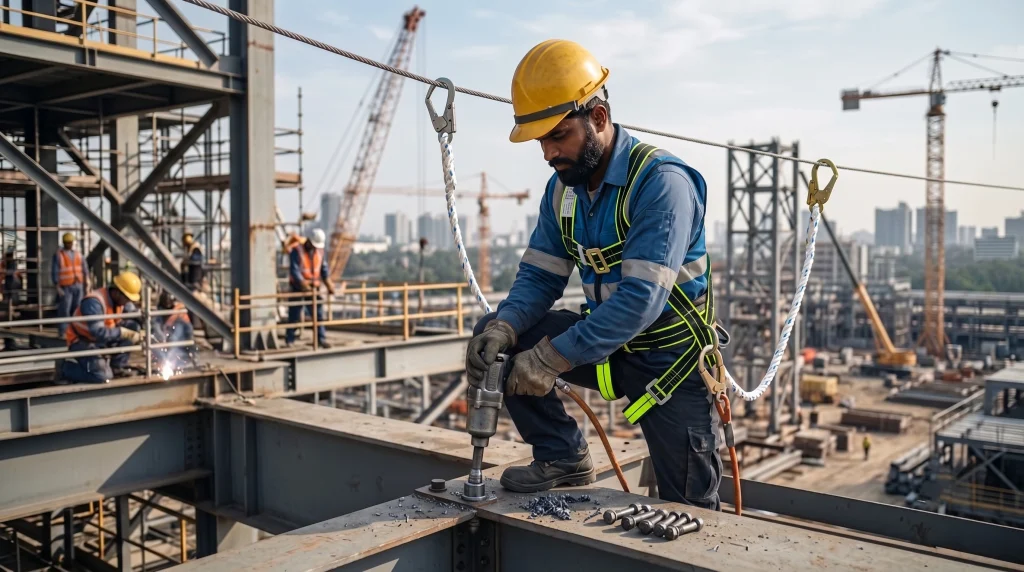
A full body harness is the primary piece of height safety equipment for any worker operating above 1.8 metres (as per Indian safety regulations and international best practice). Unlike a belt or chest harness, a full body harness distributes fall arrest forces across the chest, thighs, and shoulders — reducing injury risk during and after a fall.
What to look for:
- EN 361 certification for full body harnesses
- Dorsal D-ring for fall arrest, sternal D-ring for restraint and positioning
- Adjustable leg loops, shoulder straps, and chest strap for a secure fit
- Padding on shoulder straps for comfort during extended wear
- High-visibility webbing or reflective elements for site visibility
TIGOS range: GORILLA Full Body Harness, SPIDER Full Body Harness — both designed for construction and EPC applications.
2. Shock-Absorbing Lanyard — Critical for Fall Arrest Systems
A lanyard connects the harness to the anchor point. In a fall arrest system, a standard lanyard without a shock absorber would transmit the full force of a fall arrest to the worker’s body — potentially causing serious internal injury even when the fall itself is stopped.
A shock-absorbing lanyard contains a tear-web energy absorber that extends during fall arrest, reducing peak force on the body to safe levels.
Key considerations:
- Always use a shock-absorbing lanyard in fall arrest applications
- Check the maximum deployment length — a 2-metre lanyard with a 1.75-metre absorber deployment needs a minimum clearance of approximately 6.5 metres
- Twin-leg lanyards allow 100% tie-off when moving between anchor points
- EN 355 certification for energy absorbers
TIGOS range: ECCO1 with Shock Absorber, GORILLA with Shock Absorber, SPIDER with Shock Absorber.
3. Retractable Fall Arrest Block — For Vertical and Overhead Work
Where workers are descending ladders, working on scaffolding, or operating in vertical work zones, a retractable fall arrest block (also called a self-retracting lifeline or SRL) offers superior protection over a standard lanyard.
The retractable block automatically takes up slack as the worker moves, maintaining a taut connection at all times. In the event of a fall, the internal braking mechanism arrests the fall within a very short distance — typically 0.3 to 1 metre — significantly reducing the potential fall distance compared to a standard lanyard.
Key considerations:
- Select the correct line length for the working height
- Stainless steel cable for outdoor and corrosive environments
- Swivel top connector to prevent line twist
- Annual inspection and servicing by a competent person
- EN 360 certification for retractable type fall arresters
TIGOS range: Retractable Block — available for EPC and construction applications.
4. Carabiner and Connectors — Where the System Meets the Anchor
Every component in a height safety system is only as strong as its connectors. Carabiners and snap hooks are the critical link between the lanyard or retractable block and the harness or anchor point.
Key considerations:
- Always use locking carabiners — never non-locking snap hooks — in fall arrest systems
- Minimum gate strength of 15 kN for fall arrest connectors
- Screw-lock, twist-lock, or double-action locking mechanisms
- Aluminium for light weight, steel for high-load or abrasive environments
- EN 362 certification for connectors
TIGOS range: Carabiner — rated for fall arrest applications.
5. Descender — For Controlled Descent and Rescue
On EPC sites with elevated plant, towers, or structures, a descender device allows controlled descent from height. It is also a critical component of a site rescue plan — if a worker is suspended after a fall arrest, they must be recovered quickly to prevent suspension trauma.
Key considerations:
- Descenders must be rated for rescue loads, not just personal use
- Auto-locking descenders are preferred as they require continuous action to descend
- Every EPC site working at height should have a documented rescue plan and trained rescue team
- Rescue equipment must be accessible at the work zone — not locked in a storeroom
TIGOS range: Descender — suitable for personal descent and site rescue applications.
6. Anchor Points — The Starting Point of Every System
No height safety system can perform better than the anchor point it is connected to. On EPC sites, anchor points must be:
- Capable of withstanding a minimum force of 12 kN (as per EN 795)
- Inspected by a competent person before use on every shift
- Positioned above the worker’s dorsal D-ring wherever possible to minimise fall distance
- Never shared between more than the rated number of users
Temporary anchor devices, beam clamps, and roof anchors must all carry appropriate certification and be installed as per manufacturer instructions.
Height Safety Equipment Checklist for EPC Sites
| Equipment | Standard | Application |
| Full Body Harness | EN 361 | All work at height above 1.8m |
| Shock-Absorbing Lanyard | EN 355 | Fall arrest on horizontal surfaces |
| Retractable Block | EN 360 | Vertical work, ladders, scaffolding |
| Locking Carabiner | EN 362 | All connections in fall arrest system |
| Descender | EN 341 | Controlled descent and site rescue |
| Anchor Device | EN 795 | Fixed and temporary anchor points |
Building a Height Safety Programme for EPC Projects
Equipment alone is not enough. A complete height safety programme for EPC contractors includes:
- Risk assessment for every working-at-height task before work begins
- Equipment inspection before every use — visual check by the user, periodic formal inspection by a competent person
- Training — every worker using height safety equipment must be trained in correct fitting, use, and pre-use inspection
- Rescue plan — a documented, practised rescue procedure for every working-at-height zone
- Equipment records — serial numbers, inspection dates, and retirement records for every piece of fall arrest equipment
Conclusion
For EPC contractors, height safety is not an area where corners can be cut. The right equipment — properly selected, correctly fitted, and regularly inspected — is what stands between a near miss and a fatality.
TIGOS supplies a complete range of height safety equipment for EPC and construction applications including full body harnesses, shock-absorbing lanyards, retractable blocks, carabiners, and descenders — available across India with reliable supply for project-scale requirements.