
Introduction
Buying safety equipment is not just a procurement decision — it is a responsibility. Every helmet, harness, glove, or shoe you purchase for your workforce directly affects whether they go home safe at the end of the day.
In India, the safety equipment market is flooded with options at every price point. But not all products are built equal, and not all certifications are genuine. Whether you are an HSE manager, a procurement officer, or a business owner equipping your team, here is exactly what to look for before you buy.
1. Check for Relevant Safety Certifications
The single most important thing to verify is whether the product carries the right certification for its category. In India and internationally, the key certifications to look for include:
- BIS / ISI Mark — Bureau of Indian Standards certification, mandatory for many categories of PPE sold in India
- CE Mark — European conformity mark, widely accepted as a quality benchmark for safety products
- EN Standards — European Norms specifying performance requirements per product type (e.g., EN ISO 20345 for safety footwear, EN 388 for protective gloves)
- ANSI/ISEA — American standards, relevant for industrial and construction applications
A product without any certification is a risk you should not take. Always ask your supplier for documentation.
2. Match the Product to the Hazard
Different workplaces carry different risks. A safety shoe built for a warehouse is not the same as one designed for a chemical plant. Before purchasing, identify the specific hazards your workers face:
- Impact and compression → Steel toe safety shoes, impact-resistant helmets
- Chemical exposure → Chemical-resistant gloves, FR suits, chemical goggles
- Height work → Full-body harnesses, retractable blocks, lanyards with shock absorbers
- Dust and fumes → Appropriate respirator masks (P2, P3, or gas-specific filters)
- Low visibility environments → Reflective jackets with the right GSM and reflective tape width
Buying general-purpose PPE for a specific high-risk environment is one of the most common and costly mistakes in workplace safety procurement.
3. Verify the Supplier’s Credibility
In India, counterfeit and substandard safety equipment is a real problem. Always buy from an established, reputable supplier who can provide:
- Original certification documents for the products they sell
- Consistent product quality across batches
- After-sales support and product guidance
- A clear product range across multiple safety categories
A supplier who specialises exclusively in safety equipment — rather than one who sells safety products as a side category — will always be a more reliable source.
4. Do Not Let Price Be the Only Decision Factor
Lower-priced safety equipment almost always means one of three things: lower-grade materials, missing certifications, or inconsistent quality control. While budget is always a consideration, the cost of a workplace injury — medical, legal, and operational — will always far exceed the cost of proper certified PPE.
That said, high price does not automatically mean high quality. Always evaluate:
- The product’s certification and compliance status
- Material specifications (type of steel in toe caps, thickness of glove coating, GSM of reflective fabric)
- User reviews and industry reputation of the brand
5. Consider the Full Range of PPE Needed
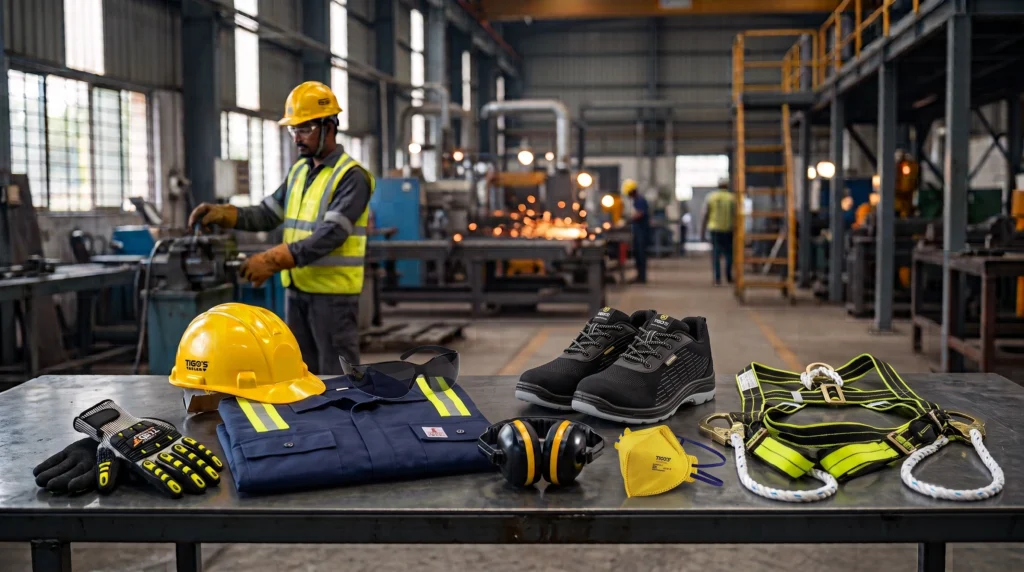
Workplace safety is not a single product — it is a system. A worker who has certified safety shoes but no gloves, no eye protection, and no respiratory protection is still exposed to serious risk. When evaluating your safety equipment needs, audit the full protection requirement:
- Head — Safety helmets
- Eyes — Safety goggles or face shields
- Respiratory — Dust masks or gas respirators
- Hands — Application-specific gloves
- Body — High-visibility jackets, FR suits, boiler suits
- Feet — Category-appropriate safety shoes
- Height — Harnesses, lanyards, retractable devices
Conclusion
Buying certified safety equipment in India requires more than just checking a price list. It requires understanding hazard types, verifying certifications, evaluating supplier credibility, and building a complete protection system for your workforce.
At TIGOS, every product in our range is selected to meet strict safety standards — from safety shoes and hand gloves to height harnesses and fire safety equipment. If you need help choosing the right PPE for your industry, our team is ready to help.
[Get in Touch with TIGOS →]